 Highlightly Team
Thought leadership on LinkedIn is not about sounding smart. It's about saying something specific, useful, and worth repeating. Here is how to write LinkedIn posts that position you as an authority - and actually get shared by the people you want to reach.
The mistake is treating LinkedIn thought leadership posts as a posting problem. It is really a source-selection problem: what proof, lesson, quote, screenshot, or customer signal is strong enough to deserve attention?
Core thesis
Lead with the evidence-backed insight message.
This is the clearest hero because it states the article promise: shared thought leadership is specific and evidence-backed, not generic advice.

Do not publish a claim you cannot trace back to a source.
Start with a report, article, webinar, customer story, screenshot, or internal note. Extract the strongest material, keep attribution visible, then design the asset around the evidence.
Workflow
What LinkedIn thought leadership actually is (and isn't)
What thought leadership is and is not
The source-backed workflow
Choose the source
Pick one credible source that already contains the evidence: a report, case study, transcript, product screenshot, customer quote, or expert note.
Extract the atoms
Pull quotes, statistics, key points, screenshots, and objections as separate candidates instead of forcing the whole source into one summary.
Match atom to format
Use stat cards for numbers, quote cards for sharp language, carousels for frameworks, screenshots for proof, and text posts for opinion plus context.
Add the human angle
Explain why the evidence matters for your audience. This is where taste, judgment, and positioning enter the post.
Export and test
Apply your Brand Kit, keep attribution visible, export in the right ratio, and test the caption or hook around the same proof.
Playbook
The four thought leadership post types that get shared
Thought leadership post formats
- Frameworks: "I've developed a 3-part framework for [common problem]" with a visual or carousel.
- Contrarian takes: "Everyone says X. Here's why the data suggests Y" with specific numbers.
- Pattern recognition: "After [doing X] 50 times, I've noticed these 3 patterns" with detailed observations.
- Practical how-to posts: "Here's exactly how we [achieved specific result]" with step-by-step transparency.
Example post
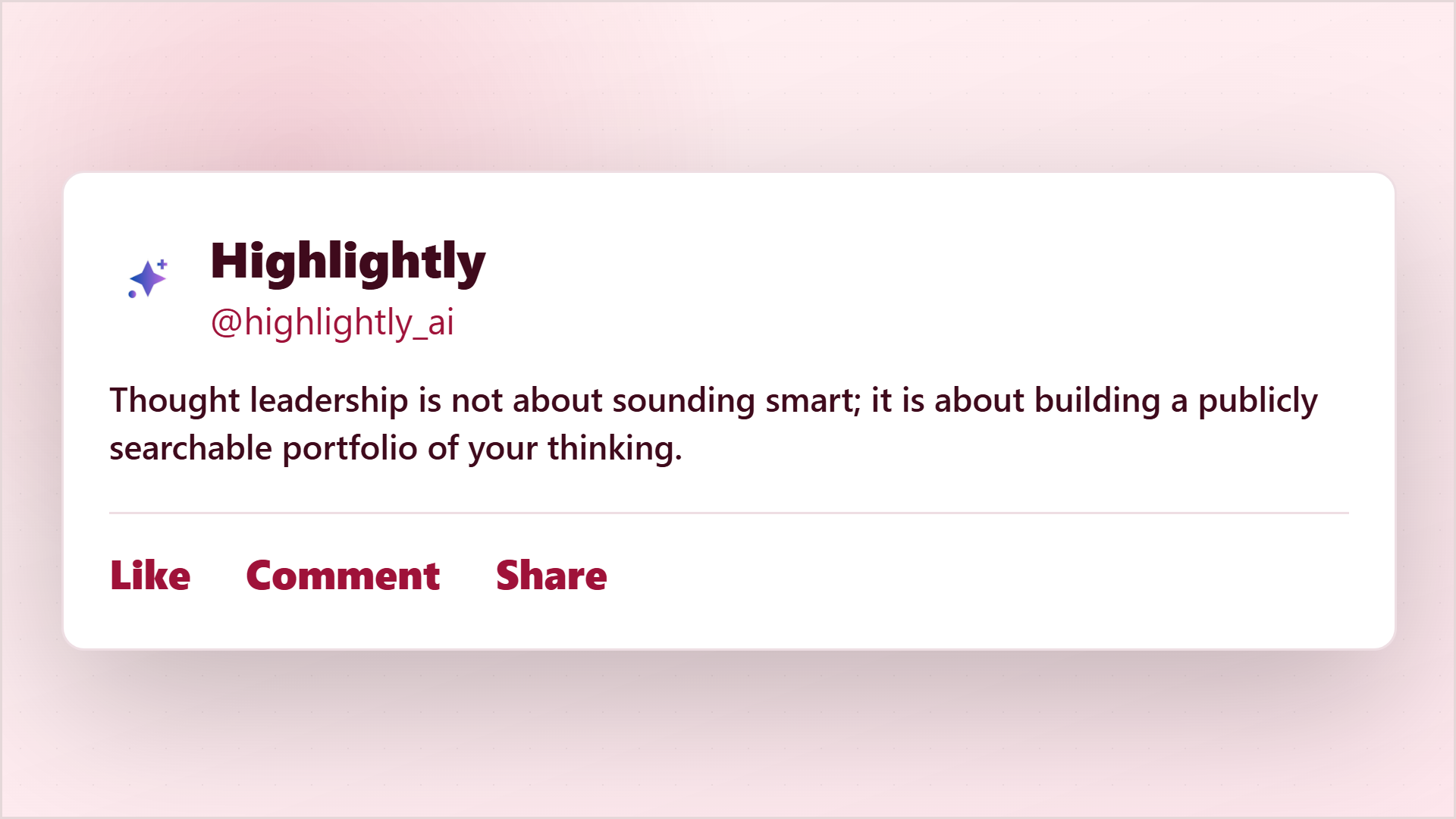
Use the LinkedIn replica when discussing searchable thinking.
The mock post works as an example of the kind of idea a reader could publish, not as the article opener.
Playbook
How to find your thought leadership angle
Find your unique perspective
- Professional experience: what you have actually done.
- Industry observations: what you have noticed that others miss.
- Data access: what you can measure or prove.
- Results: what you have achieved and what changed because of it.
- The best thought leadership comes from the specific, not the universal. Instead of "how to be productive," write "how our 5-person team ships 3 major features per month."
Match the idea to the right LinkedIn format
Playbook
The evidence layer: Why source-backed content wins
Posts that include specific evidence - data points from reports, screenshots of actual results, quotes from recognized experts, methodology details, case-specific numbers - consistently outperform posts that make claims without support. This is the single biggest differentiator between real thought leadership and generic content.
Execution
Post structure: Hook, insight, evidence, takeaway
A thought leadership post structure
Hook
Use the first 1-2 lines to make a specific, interesting promise.
Insight
Explain the core idea clearly.
Evidence
Add the data, experience, example, or reasoning that supports the idea.
Takeaway
Show what the reader should do, think, or question differently.
Engagement prompt
Ask a specific question that invites genuine discussion.
Generic LinkedIn posting vs source-backed publishing
Measurement quality
Place the saves-and-reshares asset beside the section on shares.
This image makes sense when the article explains that shared thought leadership is measured by useful distribution signals, not just likes.
Execution
Thought leadership carousels: The highest-impact format
A simple thought leadership carousel structure
Slide 1
Open with a provocative hook, claim, or clear promise.
Slides 2 through N-1
Use one point per slide with supporting detail, examples, or evidence.
Final slide
End with a summary and CTA. Carousels work because the framework becomes saveable, screenshot-worthy, and easy to reshare.
Execution
Building thought leadership consistency
Build a body of work
- Publish 1-2 substantive thought leadership posts per week.
- Repurpose long-form sources such as research, reports, and personal analysis into posts.
- Develop 2-3 core theses and explore them from different angles over time.
- Reply thoughtfully to comments because that is where deeper relationships form.
Highlightly workflow
Turn the source into assets without losing the proof
In Highlightly, the job is not to ask AI for a generic post. Import the source, review the extracted material, choose the quote, statistic, screenshot, or key point that deserves to ship, then apply templates, Brand Kit settings, captions, and export ratios.
Make it real
Build the post around proof, not vibes.
Write the opinion after the evidence. Drop the source into Highlightly, choose the proof asset, then make the post about what the proof changes.
Create source-backed graphicsThe best linkedin thought leadership: how to create posts that get shared starts before the caption.
Find the strongest source-backed idea first. The format, design, caption, and CTA become easier once the evidence is clear.
- Start from source material.
- Keep attribution and context visible.
- Use the format that makes the idea easiest to understand.
Frequently asked questions
Research sources