 Highlightly Team
Founders who share their journey on LinkedIn attract customers, investors, talent, and press - often before the product is ready. Here is the complete guide to building in public on LinkedIn: what to share, how to structure posts, and how to grow a founder audience from zero.
The mistake is treating LinkedIn for founders build in public as a posting problem. It is really a source-selection problem: what proof, lesson, quote, screenshot, or customer signal is strong enough to deserve attention?
Founder channel thesis
Lead with the simple strategic claim.
This wide asset is the right hero because it cleanly frames LinkedIn as a founder growth channel before the article gets into what to share.
Do not publish a claim you cannot trace back to a source.
Start with a report, article, webinar, customer story, screenshot, or internal note. Extract the strongest material, keep attribution visible, then design the asset around the evidence.
Workflow
Why LinkedIn is the best platform for founders (not X, not Instagram)
LinkedIn has the highest concentration of decision-makers, investors, potential hires, and B2B customers. It rewards professional insight over entertainment. It has less noise than X and more credibility than Instagram for business content. The algorithm favors text-based thought leadership over viral memes.
The source-backed workflow
Choose the source
Pick one credible source that already contains the evidence: a report, case study, transcript, product screenshot, customer quote, or expert note.
Extract the atoms
Pull quotes, statistics, key points, screenshots, and objections as separate candidates instead of forcing the whole source into one summary.
Match atom to format
Use stat cards for numbers, quote cards for sharp language, carousels for frameworks, screenshots for proof, and text posts for opinion plus context.
Add the human angle
Explain why the evidence matters for your audience. This is where taste, judgment, and positioning enter the post.
Export and test
Apply your Brand Kit, keep attribution visible, export in the right ratio, and test the caption or hook around the same proof.
Playbook
The build-in-public philosophy
What build-in-public actually means
- Share real numbers, real struggles, and real decisions.
- Avoid oversharing, invented drama, or personal disclosure that does not help the reader.
- Safe posts such as "we launched a feature" are easy but usually lower engagement.
- Vulnerable posts such as "here is our MRR, churn rate, and the hardest decision we made this month" tend to earn more trust when the context is useful.
90-day path
Use the roadmap once the article shifts from why to execution.
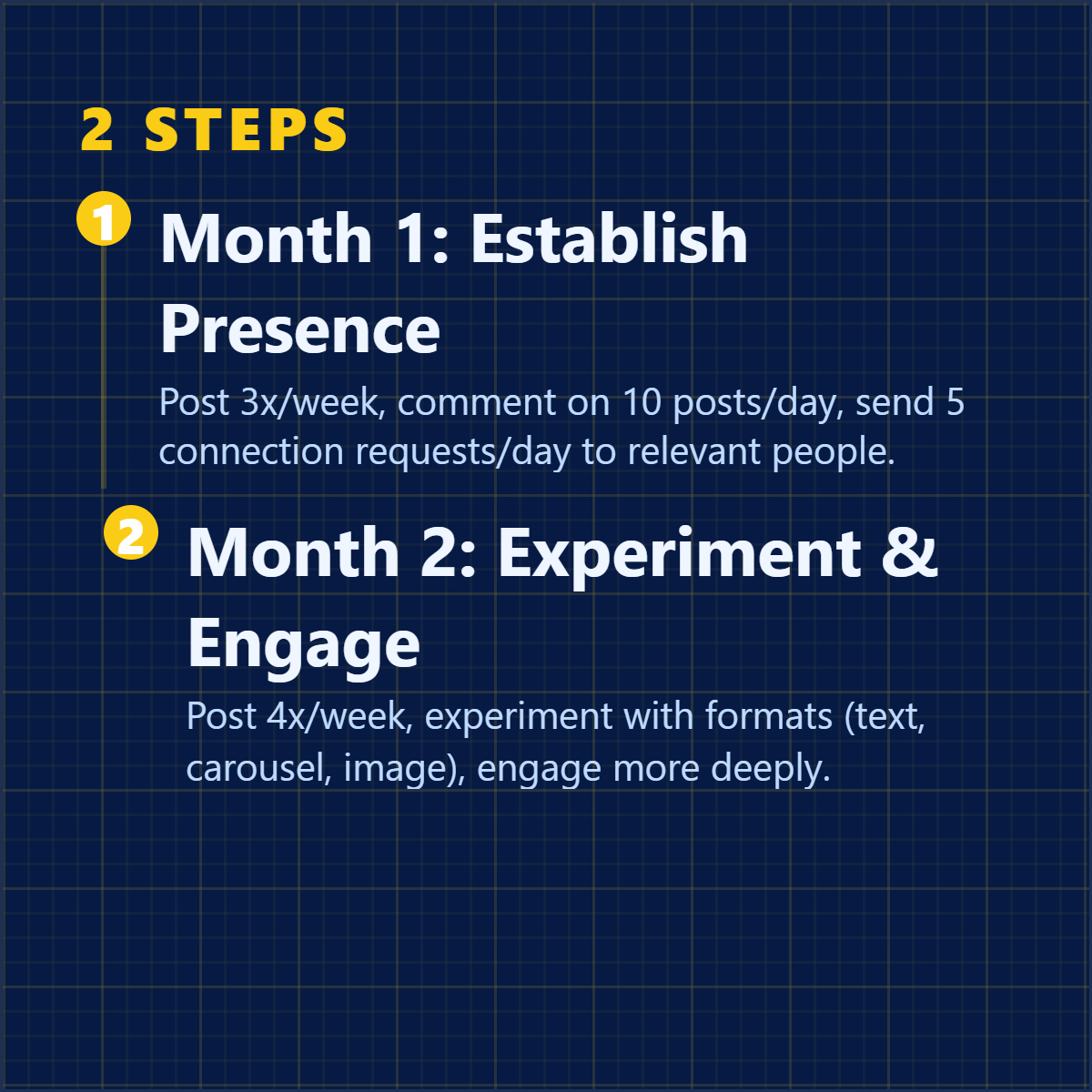
The two-month roadmap is a practical support visual for the consistency section. It should not appear before the reader understands the founder-content premise.
Playbook
What to post: The four founder content types
Founder post angles that work
- Milestones: "We hit $10K MRR. Here's what actually worked and what didn't."
- Decisions: "We chose not to raise a Series A. Here's the math behind that decision."
- Learnings: "We lost our biggest customer. Here's what we learned and what we're changing."
- Insights: "I've talked to 50 CTOs about their build-vs-buy decisions. Here are the 3 patterns I noticed."
Match the idea to the right LinkedIn format
Playbook
The founder post format that works
A founder post structure
Hook
Use 1-2 lines that are specific, honest, and grounded in a real moment.
Context
Use 2-3 short paragraphs to set up the situation.
Insight
Share the core thing you learned, changed, decided, or now believe.
Takeaway
End with 1-2 lines that make the lesson useful to another founder.
Proof
Add data, a screenshot, customer language, or another visual when it strengthens the story.
Execution
How to find content in your daily work
The content is already happening
- Customer calls become insights about what buyers want.
- Product decisions become frameworks for thinking about similar problems.
- Metric reviews become data points that other founders find useful.
- Team conversations become culture lessons.
- Industry news becomes your expert reaction. Keep a running note called "things I could post about this week."
Generic LinkedIn posting vs source-backed publishing
Execution
Growing from zero: The first 90 days
The first 90 days
Month 1: Build the habit
Post 3x/week, comment on 10 posts/day from others in your industry, and send 5 relevant connection requests/day.
Month 2: Test formats
Post 4x/week, experiment with text posts, carousels, and images, and engage with the people who comment on your posts.
Month 3: Double down
Post 5x/week, identify your best-performing content types, start using document posts or carousels, and repeat what is working.
Profile conversion
Place the profile-as-landing-page visual beside the profile optimization section.
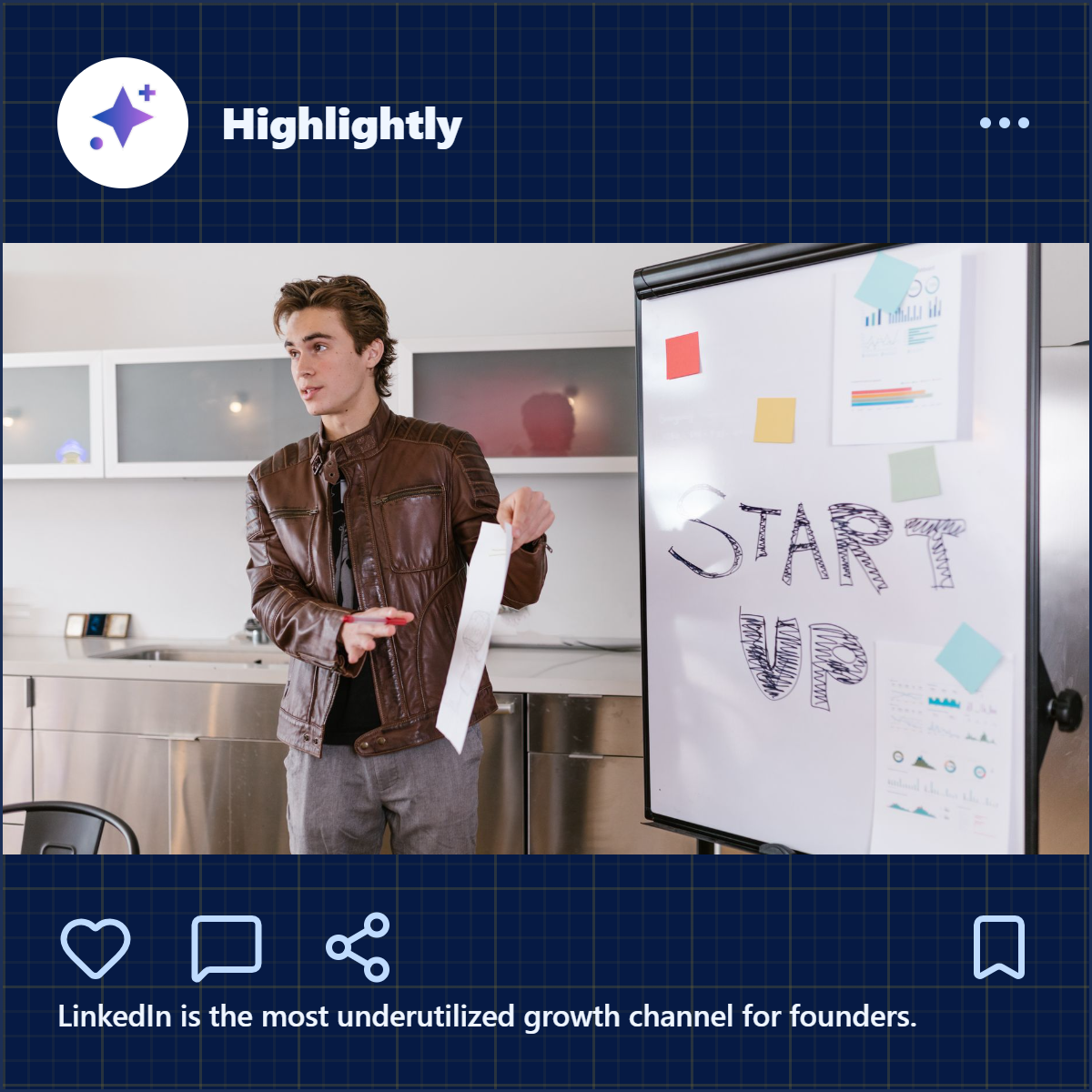
This square card is useful only when the article is explaining how a founder profile converts attention into trust.
Execution
The founder content flywheel
Post -> engagement signals -> LinkedIn shows to more people -> more engagement -> new profile visits -> new connection requests -> larger audience -> more engagement on next post. This takes time but compounds. By month 6, each post reaches 2-5x your initial audience.
Highlightly workflow
Turn the source into assets without losing the proof
In Highlightly, the job is not to ask AI for a generic post. Import the source, review the extracted material, choose the quote, statistic, screenshot, or key point that deserves to ship, then apply templates, Brand Kit settings, captions, and export ratios.
Make it real
Build the post around proof, not vibes.
Before writing another founder update, find the receipt behind it. Put that article, report, or screenshot into Highlightly and publish the lesson with proof attached.
Create source-backed graphicsThe best linkedin for founders: how to build in public and grow your reach starts before the caption.
Find the strongest source-backed idea first. The format, design, caption, and CTA become easier once the evidence is clear.
- Start from source material.
- Keep attribution and context visible.
- Use the format that makes the idea easiest to understand.
Frequently asked questions
Research sources