 Highlightly Team
LinkedIn is where B2B buyers spend their time - 4 out of 5 LinkedIn members drive business decisions. Here is a complete content strategy framework for B2B teams: what to post, how often, which formats to use, and how to turn your existing B2B content into a consistent LinkedIn presence.
The mistake is treating LinkedIn content strategy B2B as a posting problem. It is really a source-selection problem: what proof, lesson, quote, screenshot, or customer signal is strong enough to deserve attention?
Do not publish a claim you cannot trace back to a source.
Start with a report, article, webinar, customer story, screenshot, or internal note. Extract the strongest material, keep attribution visible, then design the asset around the evidence.
Content sourcing
Start the strategy with the material your team already trusts.
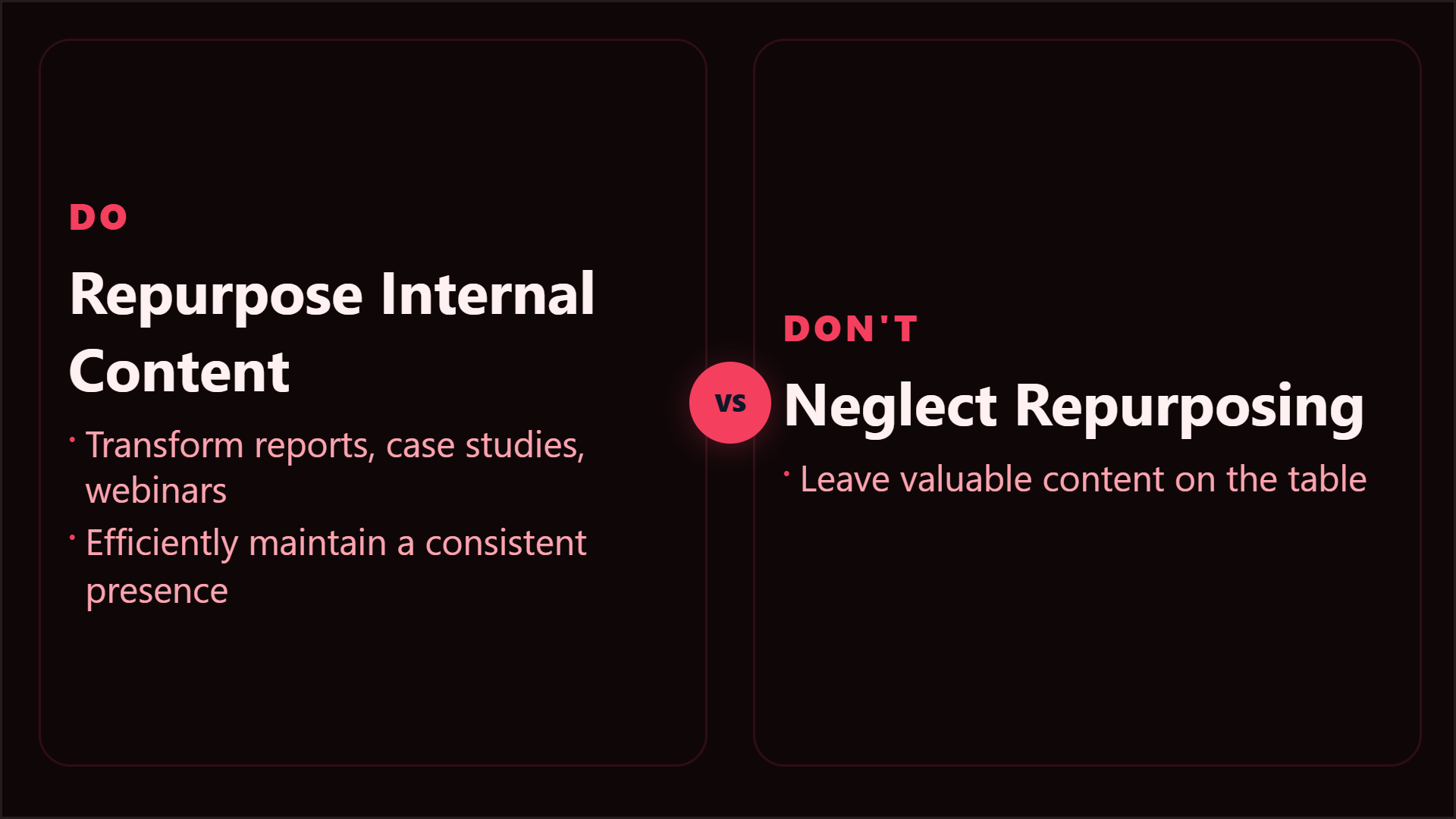
This is the best hero for the article because it shows the operating-model shift: reports, case studies, and webinars become the proof layer for a consistent B2B LinkedIn presence.
Workflow
Why LinkedIn is the primary B2B social platform
1B+ members, 4 out of 5 drive business decisions, 40% of B2B marketers say LinkedIn is the most effective channel for driving revenue. The platform's professional context makes it fundamentally different from Instagram or X for B2B.
The source-backed workflow
Choose the source
Pick one credible source that already contains the evidence: a report, case study, transcript, product screenshot, customer quote, or expert note.
Extract the atoms
Pull quotes, statistics, key points, screenshots, and objections as separate candidates instead of forcing the whole source into one summary.
Match atom to format
Use stat cards for numbers, quote cards for sharp language, carousels for frameworks, screenshots for proof, and text posts for opinion plus context.
Add the human angle
Explain why the evidence matters for your audience. This is where taste, judgment, and positioning enter the post.
Export and test
Apply your Brand Kit, keep attribution visible, export in the right ratio, and test the caption or hook around the same proof.
Playbook
The four-pillar B2B content framework
The four B2B content pillars
- Thought leadership: what you believe and why. Use this for about 30% of posts.
- Proof: evidence that you deliver results. Use this for about 25% of posts.
- Education: teaching your audience something useful. Use this for about 30% of posts.
- Culture: who you are as a team. Use this for about 15% of posts.
Playbook
Post types and formats for B2B LinkedIn
Post formats for B2B LinkedIn
- Text posts: insights, commentary, and sharp points under 2,000 characters.
- Document posts and carousels: frameworks, processes, and case studies; usually the highest-engagement B2B format.
- Image posts: quote cards, stat cards, and screenshots that are easy to share.
- Video posts: product demos, event clips, and team stories that create a more personal connection.
Match the idea to the right LinkedIn format
Playbook
The B2B content calendar template
A simple weekly B2B LinkedIn calendar
Monday
Publish thought leadership as a text post or carousel.
Tuesday
Publish proof, such as a case study, stat card, customer result, or screenshot.
Wednesday
Publish education, such as a how-to post or industry analysis.
Thursday
Publish a second thought leadership post, ideally as a discussion starter.
Friday
Publish culture, curated content, or a weekend reading roundup.
Execution
Content sourcing for B2B teams
Distribution model
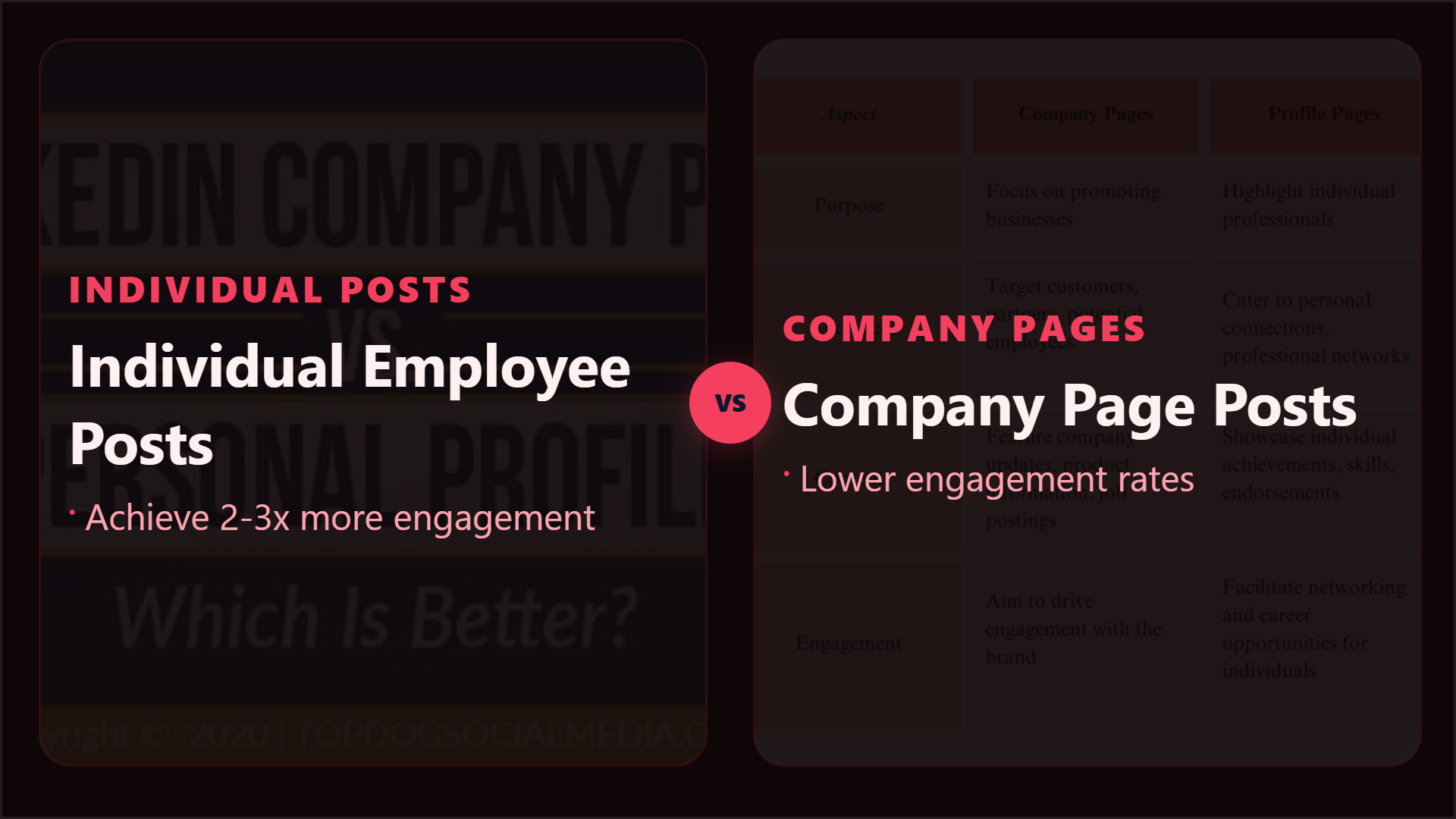
Use this visual where the article explains personal profiles versus company pages.
The image is not a general strategy hero. It belongs beside the section on who should post because it compares individual employee posts with company page posts.
Where B2B content comes from
- Internal reports and research can become stat cards, quote cards, and carousels.
- Customer conversations can become anonymized insight posts.
- Product updates and launches should become educational content, not only announcements.
- Industry news and reports work best when paired with expert commentary.
- Event and webinar recordings can be mined for transcript clips, quotes, carousels, and captions.
Generic LinkedIn posting vs source-backed publishing
Execution
Who should post: Individual vs company page strategy
Research consistently shows that individual employee posts get 2-3x more engagement than company page posts. The strategy: key team members (founders, executives, subject matter experts) post from personal profiles, company page amplifies the best content, and employees share company content to their networks. This is the LinkedIn "hub and spoke" model.
Execution
Measuring B2B LinkedIn performance
Metrics that matter
- Engagement rate, with extra attention on comments and saves instead of likes alone.
- Content-to-lead conversion: how many post viewers visit your profile or website and convert.
- Audience growth rate, especially whether you are attracting the right followers.
- Share of voice: whether your team is becoming part of the industry conversation.
- Content shelf life: how long a post continues to generate engagement after publishing.
Highlightly workflow
Turn the source into assets without losing the proof
In Highlightly, the job is not to ask AI for a generic post. Import the source, review the extracted material, choose the quote, statistic, screenshot, or key point that deserves to ship, then apply templates, Brand Kit settings, captions, and export ratios.
Make it real
Build the post around proof, not vibes.
Build next month's LinkedIn plan from sources your team already trusts: reports, webinars, customer proof, and expert notes. Highlightly turns those into the weekly assets.
Create source-backed graphicsThe best how to build a linkedin content strategy for b2b teams starts before the caption.
Find the strongest source-backed idea first. The format, design, caption, and CTA become easier once the evidence is clear.
- Start from source material.
- Keep attribution and context visible.
- Use the format that makes the idea easiest to understand.
Frequently asked questions
Research sources