 Highlightly Team
AI-generated and AI-assisted content are not the same thing. The difference is not whether AI touched the work. The difference is where the material came from and where judgment entered the workflow.
That distinction matters because fluent output can hide two very different processes: a model filling a blank with plausible substance, or a human bringing real material into a workflow where AI helps make the work faster.
AI-generated versus AI-assisted content
Generated
AI-generated content fills in the blanks
AI-generated content is useful when the goal is ideation, rough drafting, creative exploration, or a set of possibilities. The model can create a competent first pass from a short brief. But competence is not the same as specificity.
When the prompt contains only a topic, the model has to decide what is true enough, interesting enough, and relevant enough. That is a lot of editorial work to delegate to a system that does not know your audience, your source material, or the claim you actually want to make.
Assisted
AI-assisted content starts with intent and material
AI-assisted content starts with a human purpose and something concrete to work from: a report, article, transcript, customer story, product document, or research note. AI can then help read, extract, summarize, structure, caption, design, and produce variants.
Useful source-backed inputs include
- A quote from a real interview.
- A statistic from a report with its context.
- A chart or screenshot that shows the original evidence.
- A customer conversation that contains real language.
- A product document that defines the feature accurately.
- A research article that gives the idea a traceable origin.
The human layer
Judgment is not a final spellcheck
Human review should not mean scanning the last draft for typos after the model has already chosen the claim, the emphasis, and the tone. The important decisions happen earlier: what deserves attention, what needs context, which quote is fair to use, and what the audience should do with the idea.
A clear ownership model
AI surfaces options
Extract candidate hooks, quotes, statistics, facts, screenshots, and key points from the source.
Human chooses the angle
Decide what is meaningful for the audience and what point of view you want to add.
AI helps package it
Generate structure, captions, layout options, branded variants, and export formats.
Human verifies and approves
Check wording, context, attribution, readability, and whether the final asset represents the brand.
AI is not the author of your taste.
Use AI to make good judgment faster to execute, not easier to avoid. The tool can bring options to the table. You still choose what gets served.
Highlightly workflow
Make the assisted workflow visible
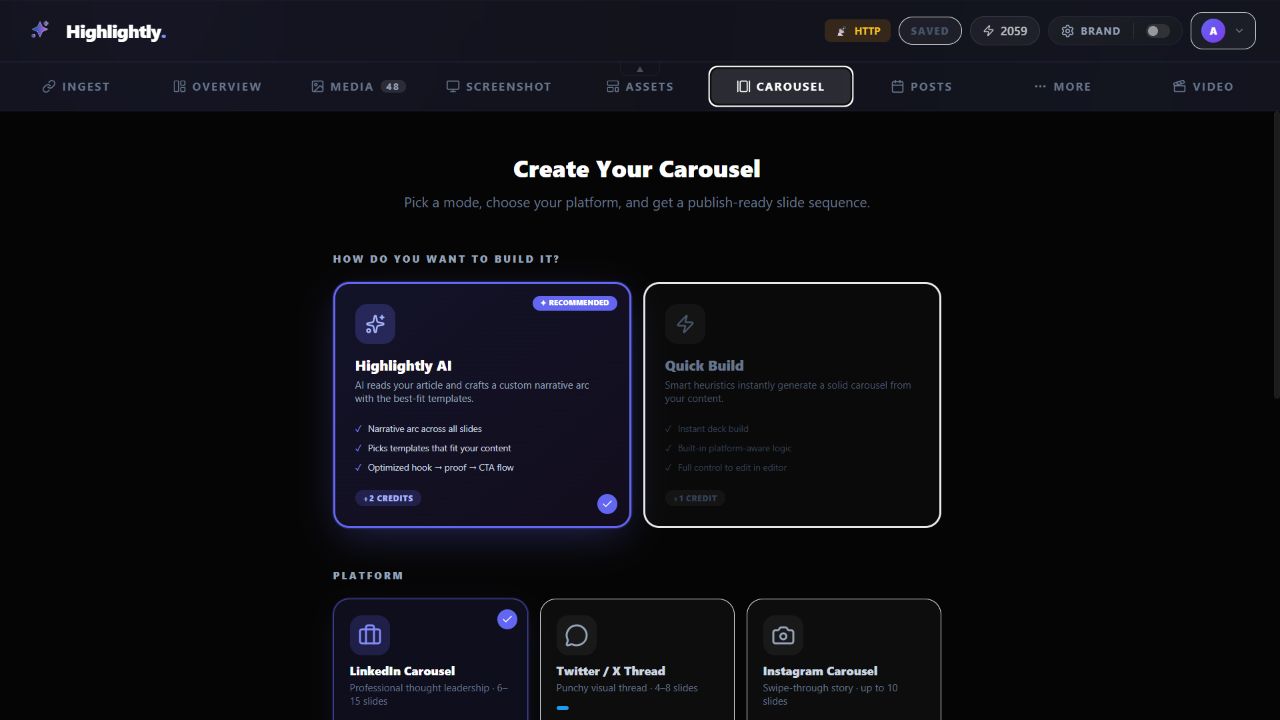
Highlightly begins with a source and exposes the material worth reviewing: quotes, statistics, hooks, facts, key points, screenshots, and source media. From there, you can choose a format, edit the content, apply the brand kit, and export a finished asset.
Try the distinction
Bring one real source into your next AI workflow.
Review what the source actually says, choose the angle yourself, then let AI handle the repetitive production work.
Build with a sourceUse AI to make judgment faster to ship.
AI-generated work can be useful for exploration. AI-assisted work is the stronger default when the content needs specificity, accountability, and a reason to trust it.
- Start with intent and material.
- Let AI handle extraction and production.
- Keep selection, framing, verification, and approval human-owned.
The useful distinction
AI-generated starts with a blank. AI-assisted starts with intent and material.
Use the extracted source as the raw material, then let AI help with structure, options, and production.
Frequently asked questions
Research sources