 Highlightly Team
Most teams are sitting on a content goldmine and treating it like a one-time announcement.
A 4,000-word report becomes one LinkedIn link. A webinar becomes one recap post. A customer story becomes one quote. Then everyone wonders why the content calendar feels hungry again by Wednesday.
That is the expensive mistake content atomization fixes. Done right, one serious source can become a week of useful social assets: quote cards, stat graphics, carousels, screenshots, captions, short scripts, newsletter sections, and sales enablement slides.
Content atomization is not making more posts. It is finding more value inside the source.
The weak version copies the same idea across platforms. The strong version extracts the best atoms, keeps the proof attached, and gives each one the format it deserves.
Plain English definition
What content atomization actually means
Content atomization is the practice of breaking one substantial piece of content into many smaller, platform-ready assets.
One report can become a LinkedIn carousel, three quote cards, two stat graphics, a newsletter section, a short video script, an X thread, a Reddit discussion prompt, and a sales slide. The source stays the same. The useful pieces inside it become separate publishing assets.
“Bad atomization repeats the headline. Good atomization finds the hidden proof, quote, number, framework, and visual that the audience actually cares about.”
— Highlightly Team
The trap
Content atomization vs repurposing: why most teams get it wrong
The poor version looks like this: take the main idea, rewrite it five times, post it on five platforms. That is not atomization. That is repetition with different fonts.
The goal is not volume. The goal is extraction. A dense source usually contains several different atoms, and each one deserves a different treatment.
A strong source may contain
- A surprising statistic that challenges an assumption.
- A quote that captures the entire argument in one sentence.
- A framework that helps the reader make a decision.
- A chart, screenshot, or methodology detail that builds trust.
- A counterintuitive finding that can start a useful discussion.
- A practical step-by-step process that belongs in a carousel.
The format map: turn each atom into the asset it deserves
Source to formats
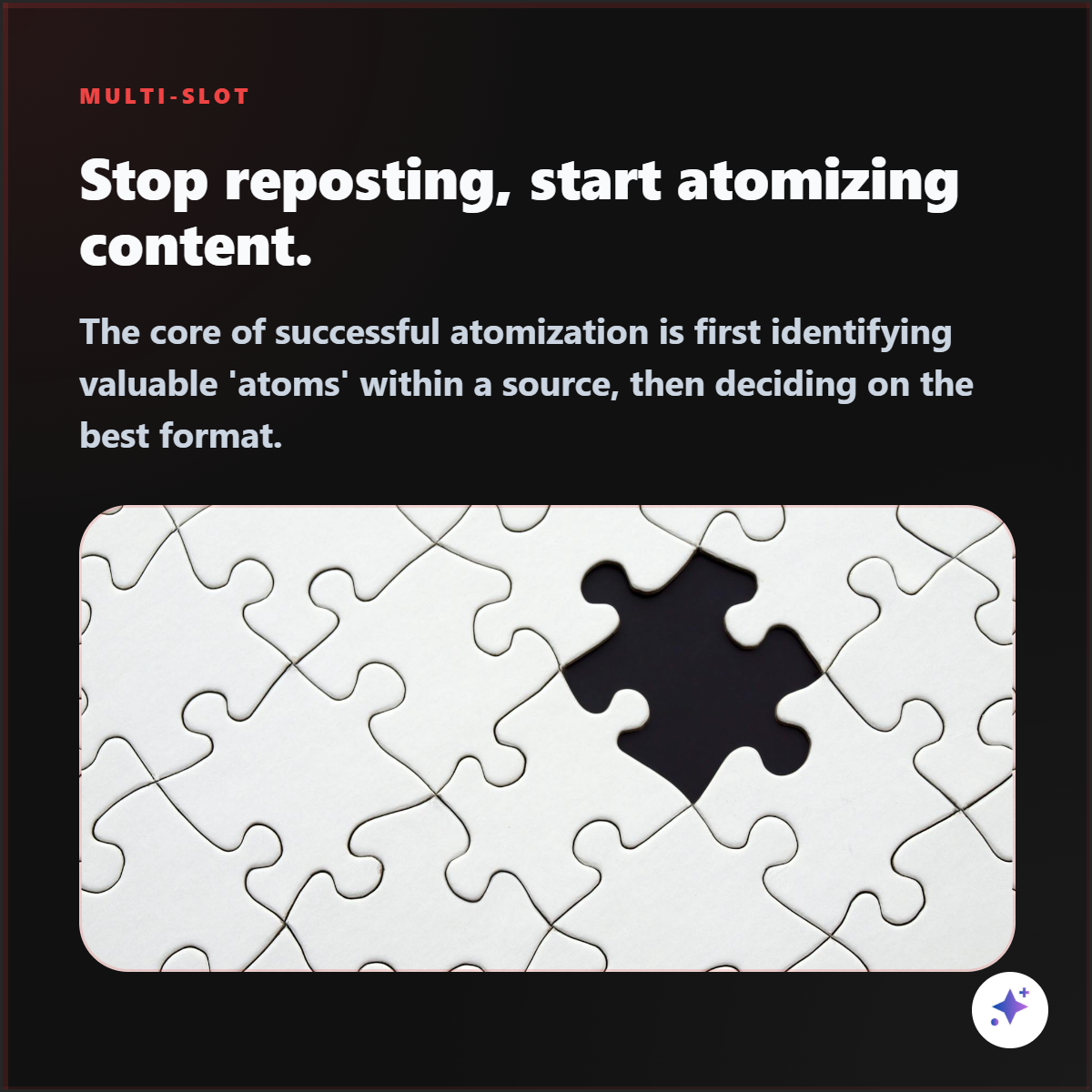
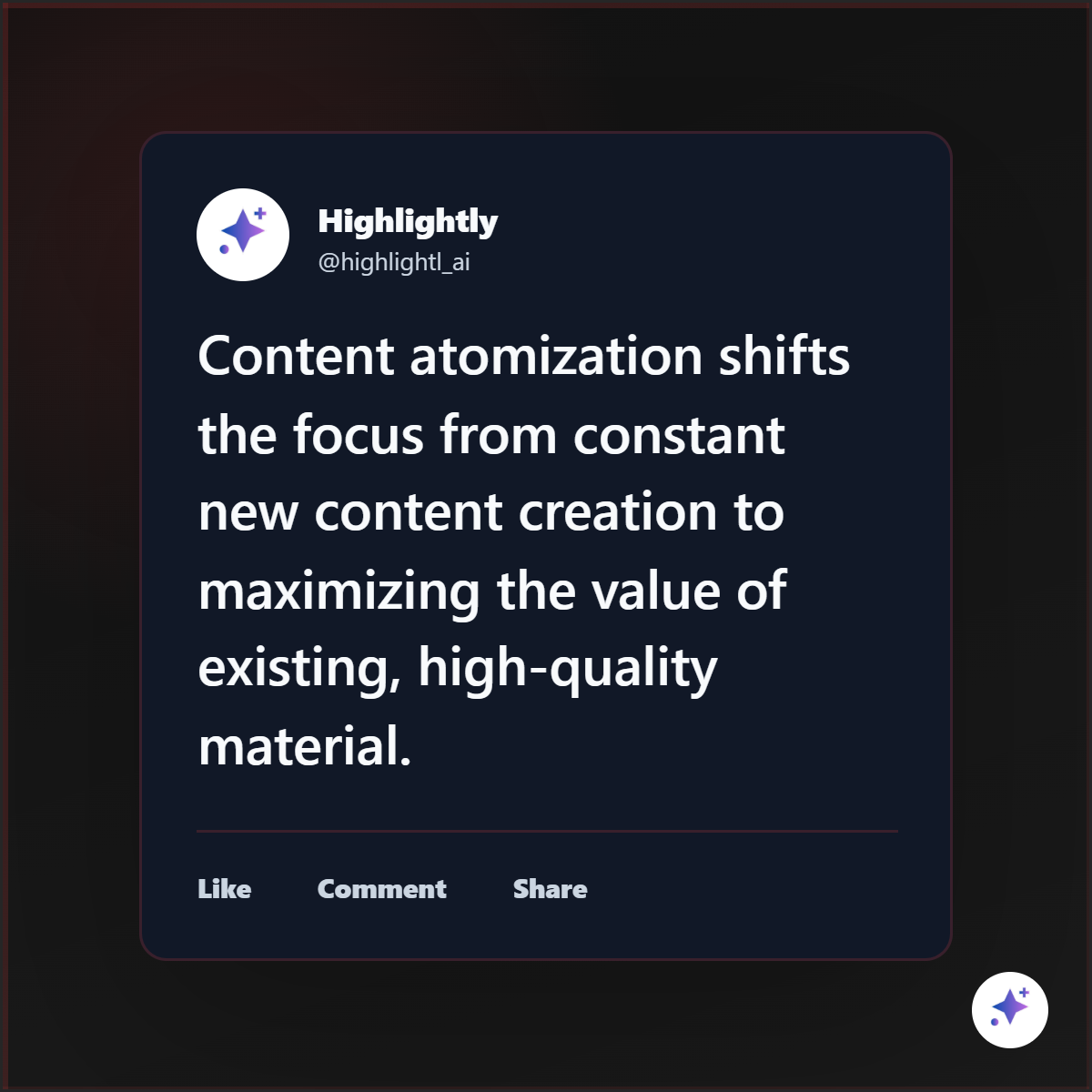
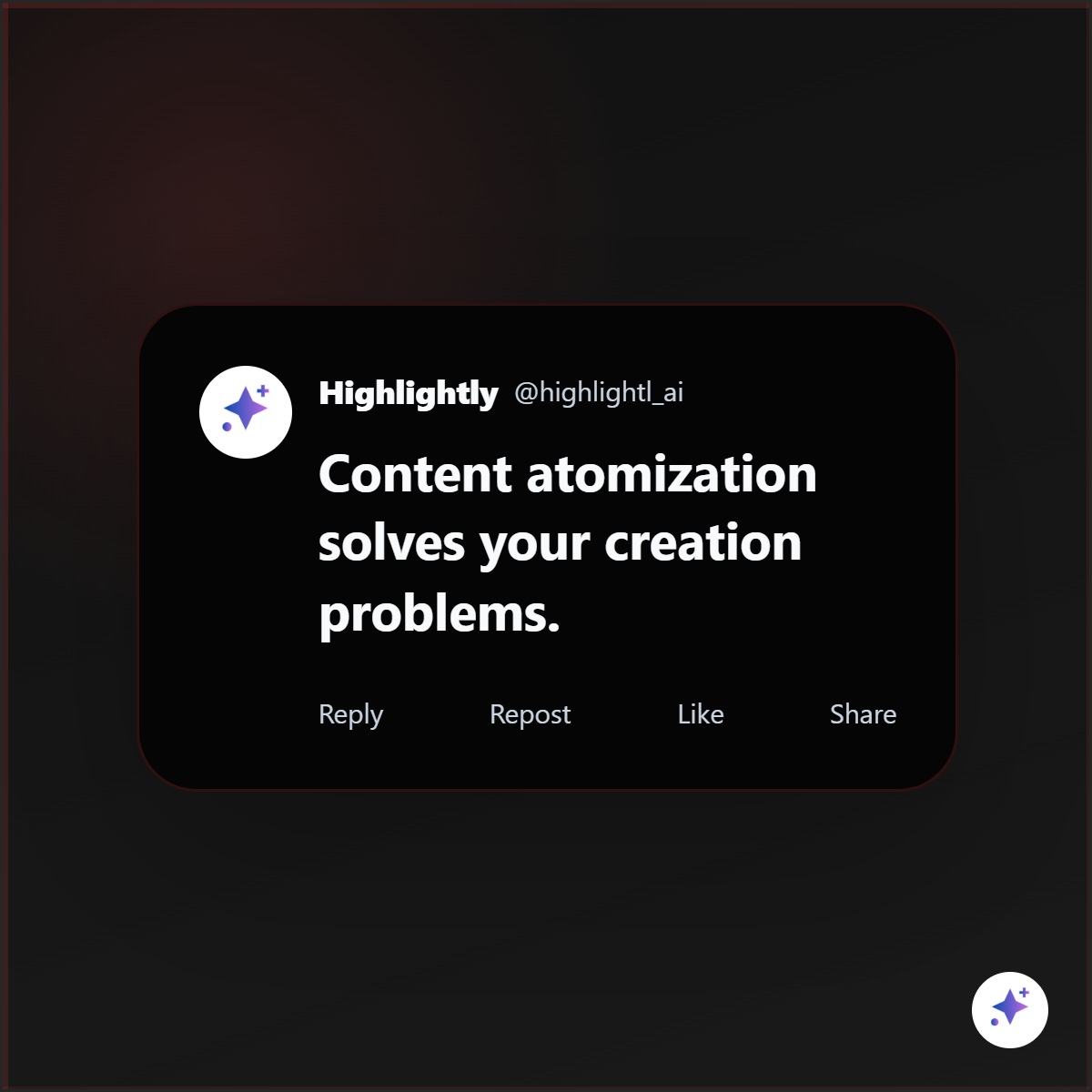
One source can become a full social asset set.
The useful parts of a source do not all belong in the same format. A quote needs a card, a process needs a carousel, and a short take needs a platform-native post.
The workflow
The source-first atomization workflow
Five steps that keep atomized content from becoming slop
Import the source
Start with the article, PDF, transcript, research note, case study, webinar, or pasted text. The source is the system of record.
Extract the useful material
Pull out quotes, statistics, hooks, facts, key points, screenshots, charts, steps, comparisons, and examples. This is where AI helps because it can read fast and surface options.
Review and choose
A human decides which atoms are strong enough to publish, which need context, and which would become misleading if cropped too aggressively.
Map each atom to a format
A quote becomes a quote card. A number becomes a stat graphic. A process becomes a carousel. A screenshot becomes an annotated card.
Brand, caption, and export
Apply colors, fonts, logo, watermark, attribution, aspect ratio, and platform-specific captions before shipping.
Example
Content atomization examples: what one article can become
Imagine a 2,500-word article about remote work trends in 2026. A lazy workflow posts the link once. A source-first workflow extracts the useful atoms and turns them into assets people can actually consume in the feed.
Six assets from one source
- A retention statistic becomes a stat card.
- A CEO quote about async communication becomes a quote card.
- A four-step async culture framework becomes a LinkedIn carousel.
- A comparison table becomes a simplified visual.
- The counterintuitive opening claim becomes a discussion post.
- The research methodology screenshot becomes an annotated source card.
Six atoms. Six different formats. One source. That is the difference between republishing and atomizing.
Highlightly workflow
AI content atomization: how Highlightly turns it into a repeatable system
AI assistance
AI helps most when it finds candidates, not when it invents the message.
The winning workflow uses AI to surface options from the source, then lets the human choose what is strong, fair, and worth publishing.

Highlightly is built around source-first atomization. Paste a URL, upload a PDF, add text, use a YouTube link or transcript, or search for an article. Highlightly extracts the material worth reviewing: hooks, quotes, statistics, facts, key points, screenshots, and caption angles.
Then the human chooses what matters. From there, the source can become branded quote cards, stat graphics, screenshots, carousels, social captions, and high-resolution PNG exports in 9:16, 1:1, or 16:9.
Manual repurposing vs source-first atomization
Who needs it
Who should care about content atomization
Content atomization is especially useful for
- Content marketers who process multiple sources per week.
- Founders who want to turn research and product updates into a consistent social presence.
- Agencies managing multiple client brands and recurring content calendars.
- B2B teams sitting on reports, case studies, webinars, and white papers.
- Newsletter writers who want every edition to create more than one post.
Try it
Put one source through the atomization test.
Paste a URL, upload a PDF, or add text. Review the extracted atoms, choose the strongest ones, then turn them into branded social assets.
Start atomizingVerdict: one good source should create more than one good post.
Content atomization is the practical way to get more value from the material you already trust. The trick is to extract real atoms, preserve attribution, and design each one for the format where it will make sense fastest.
- Do not turn every source into a generic summary.
- Do extract the quote, stat, framework, screenshot, and debate-worthy angle inside it.
- Use AI for speed, but keep the human editorial layer in charge.
Platform examples
Atomized content should look native where it ships.
Frequently asked questions
Research sources