 Highlightly Team
A podcast episode can contain an hour of useful thinking and still produce a weak social post if the repurposing step removes the question, speaker, or qualification that made the answer meaningful.
The goal is not to squeeze every sentence into a content calendar. It is to find a few complete ideas, preserve who said them, and give each idea a format that helps the audience understand it.
Start with the episode's promise, not a random transcript highlight.
Write down the conversation's central question. Then select the smallest set of transcript moments that answer it, complicate it, or give the listener a practical next step.
The source is rich; the feed is not
Why transcripts need editorial judgment
Spoken language contains false starts, repeated phrases, references to earlier context, and ideas that only make sense when paired with the host's question. A transcript extractor can surface candidates, but a person still decides whether a candidate is complete and fair.
Reject a candidate when it is
- A fragment that depends on a question the audience cannot see.
- A strong-sounding sentence that loses an important qualifier when shortened.
- A claim with no speaker, timestamp, episode, or source link.
- A generic motivational line that does not represent the episode's actual value.
Use a four-pass transcript workflow
Conversation to asset
Use the transcript as a source library, not a script to copy wholesale.
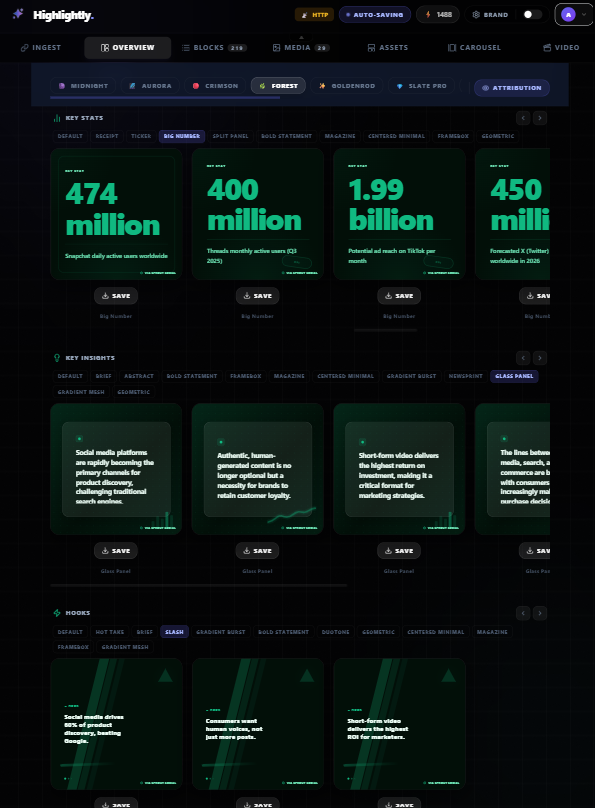
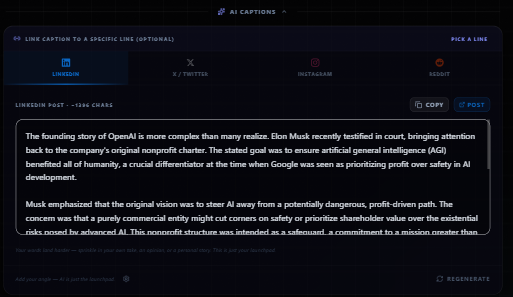
Highlightly surfaces candidate moments; the editor still chooses which answer, quote, or sequence deserves a public format.
From conversation to reviewed asset
1. Establish the episode promise
Name the audience, question, and practical outcome in one sentence. This becomes the filter for every candidate moment.
2. Extract moments by job
Collect one answer, one memorable explanation, one concrete step, one disagreement, and one question worth continuing.
3. Preserve the source trail
Keep speaker, timestamp, episode title, host, and link beside each candidate. Do not turn paraphrase into a quote.
4. Match the format to the moment
Use a quote card for a complete line, a carousel for a sequence, a stat card for a verified number, and a caption for the discussion around it.
Moment-to-format mapping
Attribution is part of the asset
Build the quote card around the speaker
A quote card should make the speaker and the source easy to identify. The episode title, guest, and timestamp can sit in a small attribution strip; the main card should still have enough context that it is not mistaken for a brand claim.
A shorter quote is not automatically a better quote.
If removing six words changes the speaker's position, keep the longer version or use a clearly labeled paraphrase instead.
Turn the episode into a short carousel
A seven-slide conversation arc
Cover
State the audience question in plain language.
Setup
Introduce the guest or the episode context without overselling it.
Answer
Show the strongest complete answer with attribution.
Explanation
Translate the reasoning into a concise, source-faithful point.
Application
Show what a reader can try or watch for in their own work.
Caveat
Add the condition or limitation that keeps the lesson honest.
Source CTA
Link to the full episode and invite the audience to listen for the surrounding context.
Review before the asset leaves the editor
Use this final pass
- Play or read the original moment once more.
- Check every quote character-for-character against the transcript.
- Confirm the speaker, episode title, timestamp, and link.
- Check that the caption does not imply the guest endorsed a claim they did not make.
- Read the card at phone size and remove any decorative element that competes with the words.
Try Highlightly
Turn your next episode into a reviewed asset set.
Paste a YouTube link, add a transcript, or upload a document. Review the extracted moments, choose the formats, and keep the episode source attached.
Start from a sourceThe best podcast repurposing is selective.
A conversation becomes valuable social content when the audience can understand the idea, trust who said it, and find the full episode.
- Use the transcript as evidence.
- Choose fewer, stronger moments.
- Keep attribution and context visible.
Frequently asked questions
Research sources