 Highlightly Team
Content atomization is often described as “turn one article into ten posts.” That framing encourages volume before judgment. A better system asks which source units can help which audiences make which decisions, then assigns a format to each job.
Build the matrix around evidence and audience jobs.
Start with the source's strongest claims, quotes, examples, numbers, and steps. Then map each to a different reader need: understand, compare, save, discuss, or act.
The matrix columns that matter
Atomization matrix
Build the matrix in five passes
From source to distribution system
1. Inventory the source
List the article's main argument, evidence, examples, quotes, steps, objections, and next actions.
2. Name audience jobs
Write the questions your readers have: What is this? Why does it matter? How do I do it? Which option fits?
3. Assign distinct formats
Choose stat cards, quote cards, carousels, threads, checklists, screenshots, or captions based on the job—not because the platform has a template.
4. Add owners and review gates
Every row should have a person responsible for checking the source and approving the final asset.
5. Sequence the week
Order the assets so each one creates a new entry point or sends the audience to the canonical source.
Example: one report, five different jobs
A differentiated week
One source, distinct jobs
Map evidence to formats before you start making files.
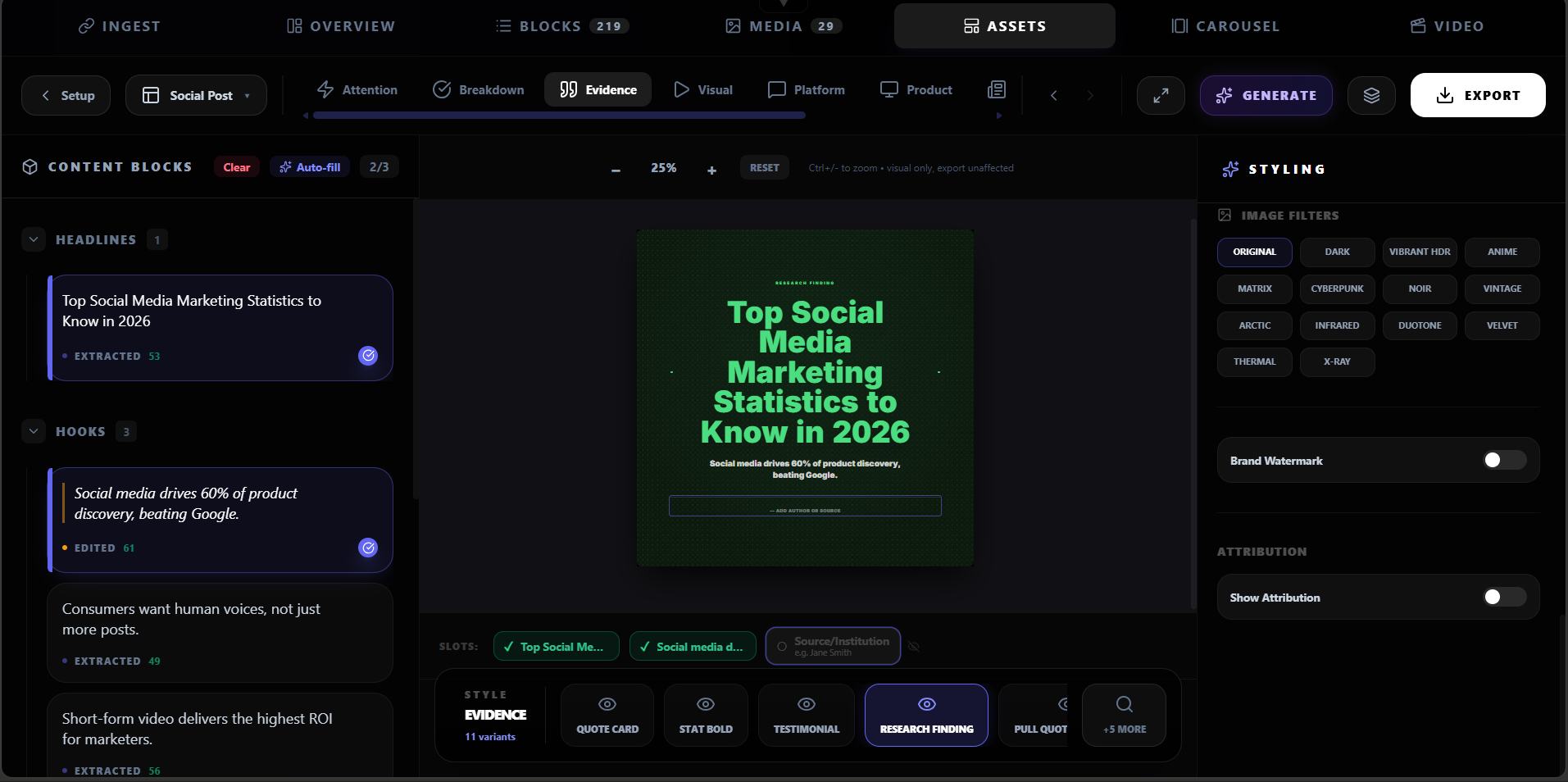
A multi-slot output is useful here because it illustrates the planning idea: one source can produce different assets when the jobs are genuinely different.

Keep the canonical source visible
A matrix should create paths back to the strongest page, report, or case study. Use internal links, source strips, and clear captions. If the derivative asset is more dramatic than the source, the system is probably optimizing for attention at the expense of trust.
Measure the system, not the file count
Useful questions after publishing
- Which source units earned meaningful attention or clicks?
- Did different formats reach different audiences?
- Which assets drove readers to the canonical page?
- Where did review catch a weak claim or missing context?
- Which rows should be retired because they repeat another job?
If two rows have the same source, audience, job, and CTA, merge them.
Changing the background or headline is not atomization. It is duplication unless the asset gives the reader a different way to understand or act.
Try Highlightly
Build an atomization matrix from a real source.
Highlightly helps you inspect the source units first, then choose the hooks, proof, captions, cards, and carousel sequence that deserve to ship.
Start from a sourceAtomization is a system for useful reuse.
Make every asset earn its place by serving a distinct reader job and keeping the canonical source easy to find.
- Map evidence first.
- Give each asset a job.
- Review and measure the system.
Frequently asked questions
Research sources