 Highlightly Team
Most B2B teams do not have a content shortage. They have a conversion problem between existing knowledge and publishable assets.
The proof is already scattered across reports, webinars, case studies, product notes, sales decks, customer calls, support docs, and executive interviews. The team just needs a repeatable way to turn that material into social assets people can understand.
Stop asking what to post. Start asking what source deserves to travel this week.
A B2B repurposing workflow works best when every post starts from something real: a finding, quote, customer detail, product screenshot, or expert explanation.
Inventory
Build a source inventory before you build a calendar
A content calendar without a source inventory becomes a list of prompts. A source inventory gives the team a concrete starting point: what exists, where it lives, who owns it, and what kind of social atoms it might contain.
B2B source to social format map
Workflow rail
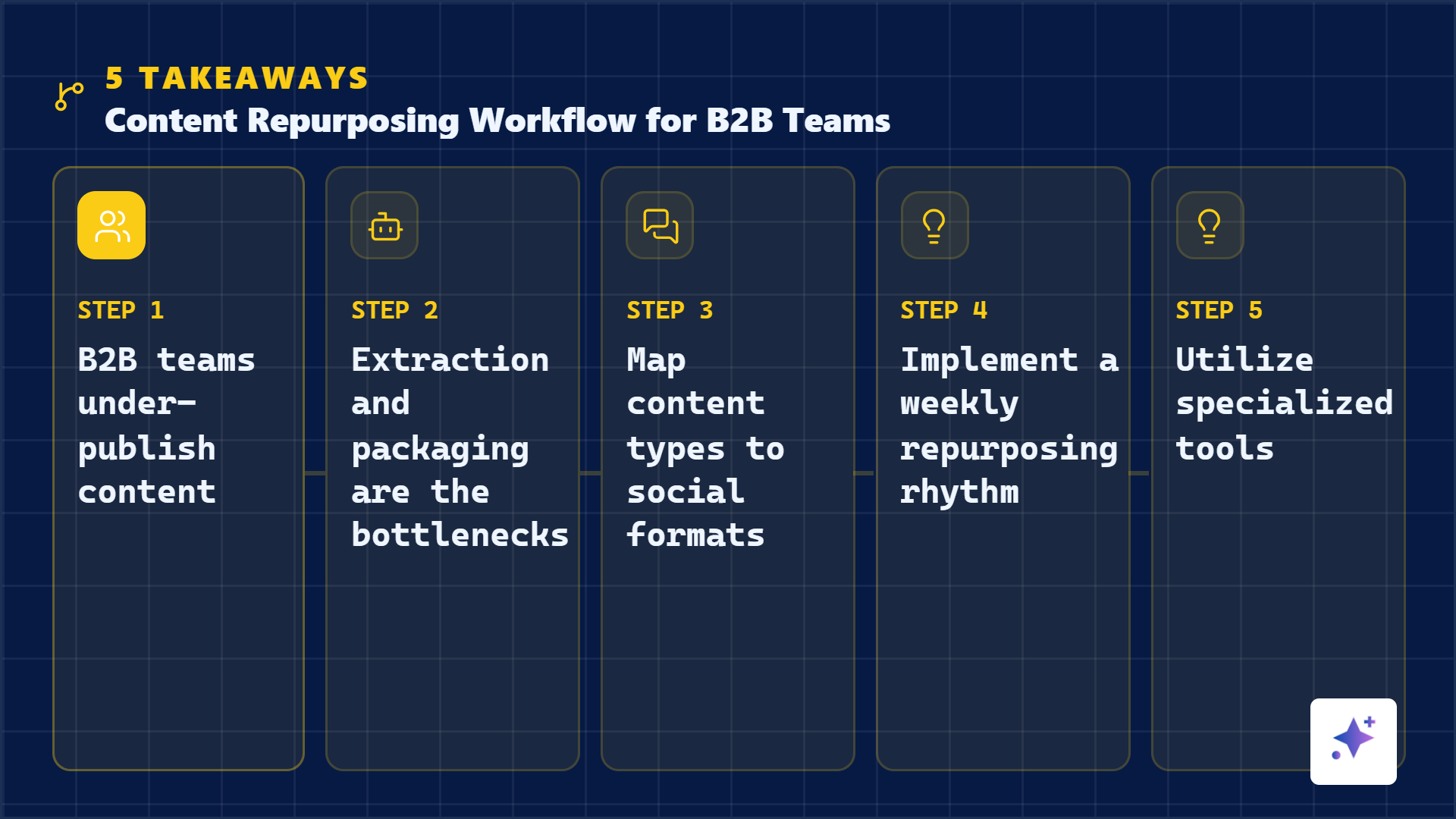
A repeatable B2B repurposing system starts with existing sources.
The source inventory becomes the production engine: extract atoms, map formats, review claims, and publish assets that carry proof.

Extraction
Extract atoms before assigning formats
Do not decide that every source must become a carousel. First extract the atoms: quotes, stats, hooks, facts, screenshots, steps, comparisons, and objections. Then decide which format each atom deserves.
A weekly B2B repurposing workflow
Choose the source
Pick one report, webinar, case study, article, or product note that supports a business priority.
Extract the atoms
Pull quotes, statistics, screenshots, hooks, customer proof, and frameworks.
Map atoms to formats
Match each atom to a quote card, stat card, carousel, screenshot, text post, or caption.
Review for accuracy
Check attribution, claims, caveats, brand voice, and whether sales or product needs to approve it.
Publish and reuse
Schedule the assets, hand useful proof to sales, and keep the source inventory updated.
Quality
Use review gates so repurposing does not become slop
B2B content often supports expensive decisions. That means the workflow needs quality gates. A source-backed asset should pass four checks before it ships: Is it accurate? Is it attributed? Is it useful to the target buyer? Does it sound like the brand?
Review every repurposed asset for
- Claim accuracy and source support.
- Visible attribution for quotes, stats, and research.
- Buyer relevance: why this matters now.
- Brand fit across visual style and voice.
- A clear next action: save, discuss, read, compare, or try.
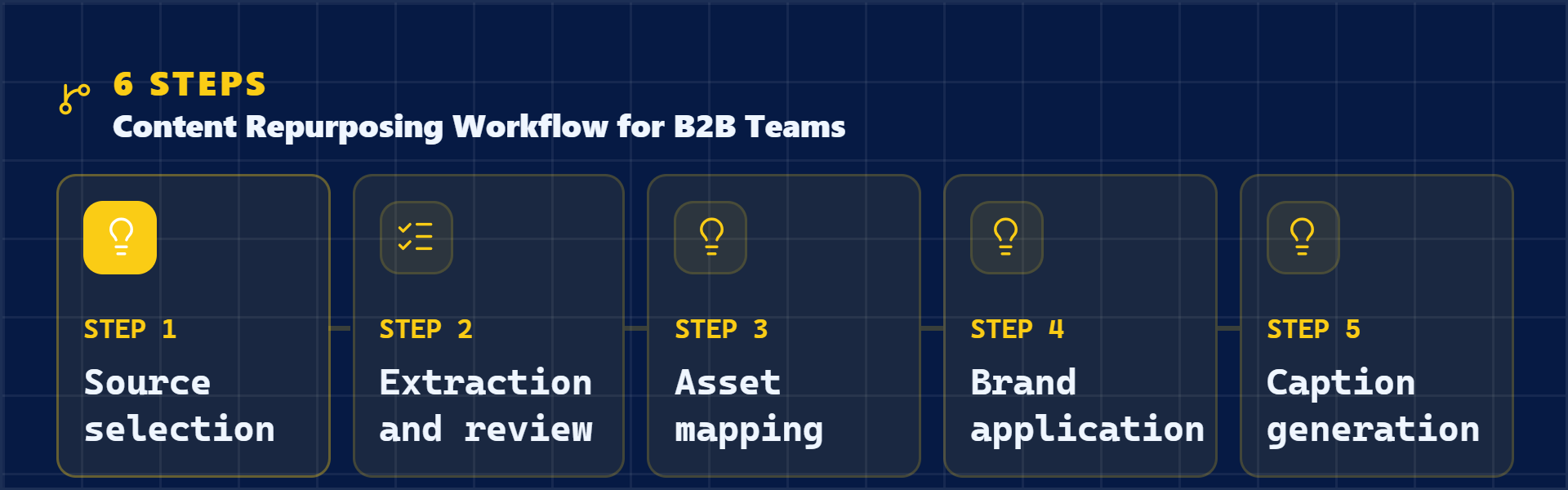
Wide checklist
Use a compact checklist when the team needs a production reminder.
Short wide graphics work well in decks, internal docs, and recap posts where the workflow is more important than the card itself.
Tool stack
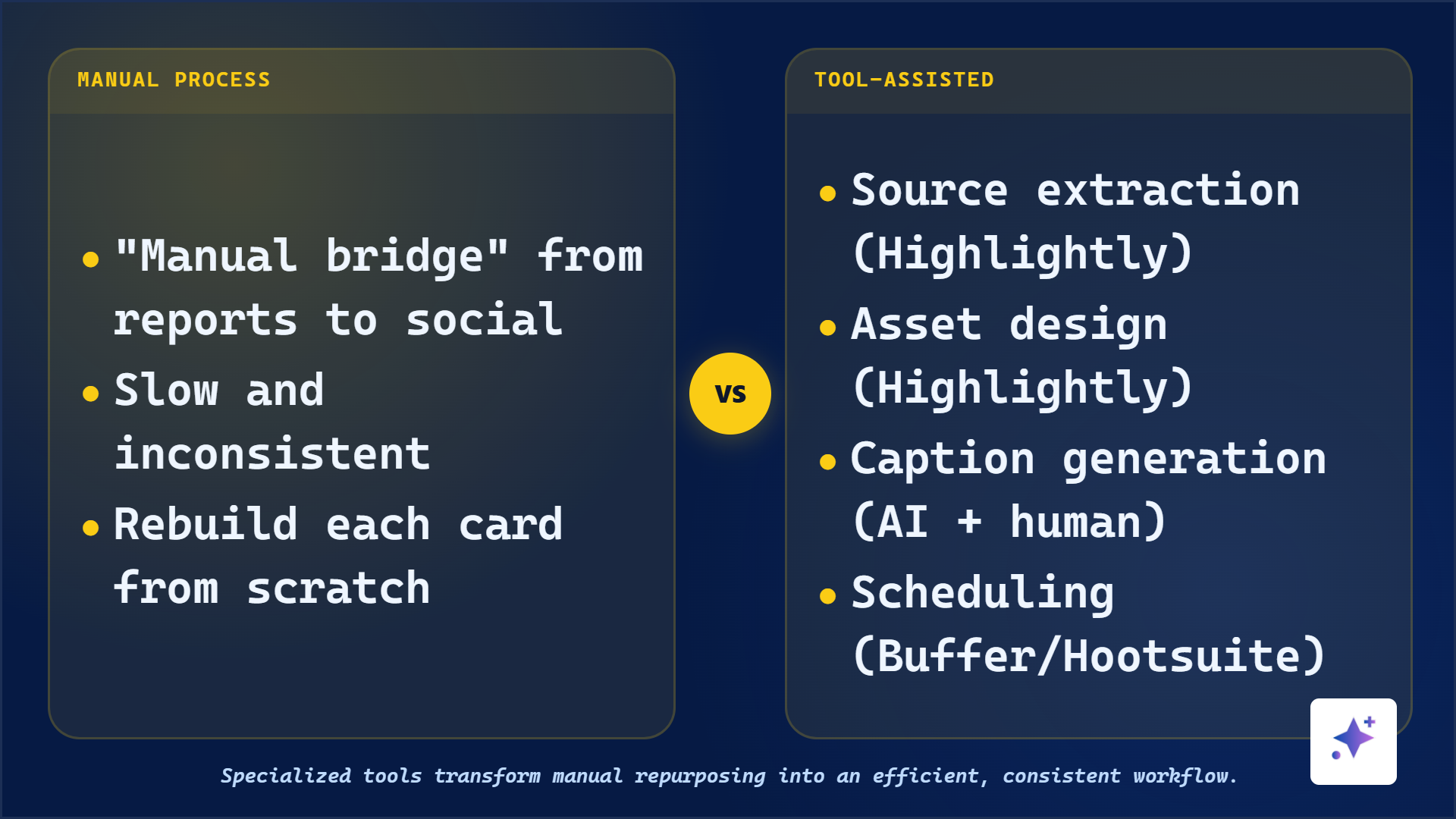
Separate creation, review, and scheduling
A healthy B2B workflow does not force one tool to do every job. Use a source-to-asset tool for extraction and design, a human review process for accuracy, and a scheduler or CRM workflow downstream when the asset is ready.
Manual B2B repurposing vs a source-to-social workflow
Build the workflow
Turn one B2B source into a publishable asset set.
Use Highlightly to extract the proof, choose the right formats, apply your brand kit, and export social-ready assets for the week.
Start repurposingThe best B2B repurposing workflow is source-led.
Teams publish more consistently when they stop inventing from scratch and start extracting from the expertise they already own.
- Inventory the sources.
- Extract atoms before choosing formats.
- Review every claim before it ships.
Frequently asked questions
Research sources