 Highlightly Team
An article and an X thread do different jobs. The article can build a case with room for detail; the thread must earn the next read one post at a time. Good repurposing keeps the argument but changes the pacing.
Choose one article angle and build a sequence around it.
The angle might be a surprising finding, a practical framework, a mistake to avoid, or a decision guide. The thread should not attempt to reproduce the entire article.
Find the thread-worthy angle
Start with one of these
- A question the article answers better than the common advice.
- A short framework with a clear order.
- A result that needs a little context to be understood.
- A before/after process with a specific lesson.
- A common mistake followed by a source-backed correction.
Thread structure
Select one angle, then let each post move the reader forward.
A generated X-style card is useful for the hook or the strongest proof point; the full article remains the canonical source.

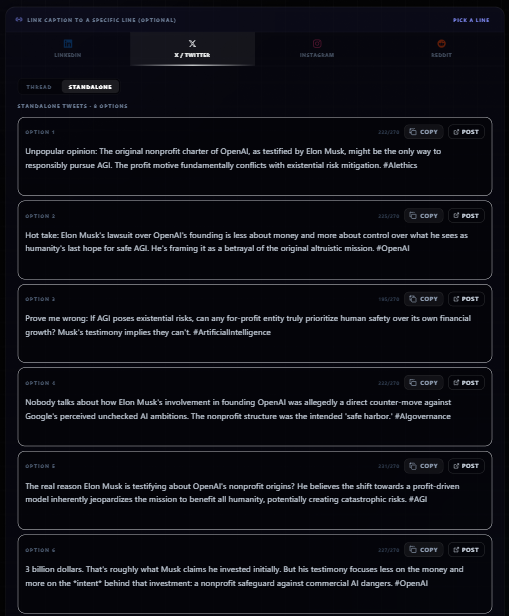
Map the article before writing posts
Thread map
Write a source-faithful sequence
From article to thread
1. Write the promise in one line
If the promise needs three sentences, the angle is not yet focused.
2. Select three to five proof points
Choose the evidence that moves the argument forward. Do not collect points only because they are interesting.
3. Draft each post as a complete unit
A reader who sees one post out of context should still know whether it is a quote, a claim, an example, or your interpretation.
4. Add connective tissue
Use transitions that explain why the next post follows. Avoid “thread” as a substitute for structure.
5. Link to the source
End with the article, author, and any relevant caveat so the thread remains an entry point, not a detached claim.
Use visuals selectively
A visual thread can help when the source contains a number, comparison, checklist, or sequence. Do not put every post inside a screenshot-like card. Use one or two generated visuals where they improve recall, and let the text carry the rest.
A useful thread visual
- Makes one claim easier to remember.
- Shows the relationship between two options.
- Turns a list of steps into a scannable sequence.
- Includes source context rather than only a decorative headline.
Edit for compression, not distortion
Shortening a sentence is editorial work. Removing the condition that makes the sentence true changes the claim. When a point cannot survive compression, keep more context or choose another point.
Try Highlightly
Turn one article into a focused thread and asset set.
Paste the article, review the strongest hooks and proof points, then build the thread around the angle that deserves the reader's attention.
Start from a sourceA good thread is a guided path into the article.
Give the reader a promise, evidence, meaning, and a clear next step—then let the complete source carry the depth.
- One angle beats a full summary.
- Each post needs a job.
- Link back to the source.
Frequently asked questions
Research sources