 Highlightly Team
Case studies already contain the ingredients of a strong social post: a problem, a decision, a change, a customer voice, and evidence. The risk is that social formatting compresses the story until the result sounds bigger or more universal than the source supports.
Treat the case study as proof, not as a testimonial slogan.
A credible post shows what changed, for whom, over what period, and how it was measured. It also gives readers a path to inspect the complete story.
Do this before designing
Separate four kinds of case-study material
Proof inventory
Use a source-to-proof workflow
Proof before polish
Select the result and the customer voice before choosing the visual treatment.
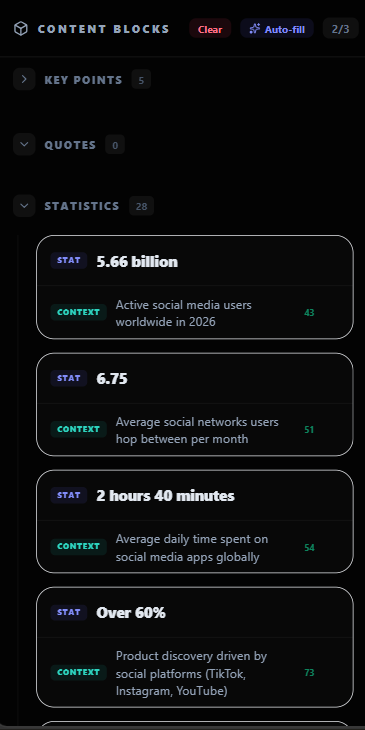
The source card pattern works for case studies because it keeps the claim, context, and attribution together.

From customer story to publishable asset
1. Find the starting problem
Write the customer situation in one sentence. If the case study does not state a baseline, do not invent one.
2. Identify the intervention
Capture what changed in the process, product, team, or decision. This is what makes the result more than a lucky number.
3. Pull the proof
Select one result and one quote. Keep the original unit, timeframe, and measurement language.
4. Choose the asset job
Use a stat card for a clean measured result, a quote card for voice, and a carousel when the audience needs the full sequence.
5. Link to the complete evidence
Use the CTA and caption to send the reader to the full case study, methodology, or customer page.
Build a before/after card carefully
Before/after graphics are useful because the contrast is immediate. They are also easy to misuse. Only show both sides when the source gives both sides, and label whether you are comparing a process, a metric, a timeframe, or a customer experience.
A safe proof card includes
- The exact metric and unit, not just a large percentage.
- A baseline or comparison point when the source provides one.
- The timeframe and population or customer scope.
- A small source strip with customer story title and attribution.
- A note when the result is directional, self-reported, or limited to one customer.
Turn the story into a carousel
A six-slide customer proof arc
Problem
What was difficult before the change?
Constraint
What made the problem worth solving now?
Intervention
What did the team actually do?
Evidence
What changed, and how was it measured?
Customer voice
Show the exact quote that adds meaning to the number.
Lesson and source
State the transferable lesson carefully and link to the full case study.
Keep the caption honest
The caption should not upgrade “this customer saw X” into “you will see X.” It can explain why the story matters, invite readers to inspect the details, and describe the workflow without promising the same outcome to every team.
Ask: what would a skeptical reader need to know?
If the answer includes a timeframe, baseline, cohort, sample, implementation detail, or limitation, make room for it in the asset or caption.
Try Highlightly
Turn one customer story into a proof-led asset set.
Upload a case study or paste the source. Highlightly can surface quotes, stats, and key points so the team can choose the proof before designing the card or carousel.
Start from a sourceCustomer proof earns trust through specificity.
The strongest case-study post makes the result clear while leaving enough context for the reader to understand what the result does—and does not—mean.
- Keep the customer voice exact.
- Attach context to every number.
- Link back to the complete story.
Frequently asked questions
Research sources